
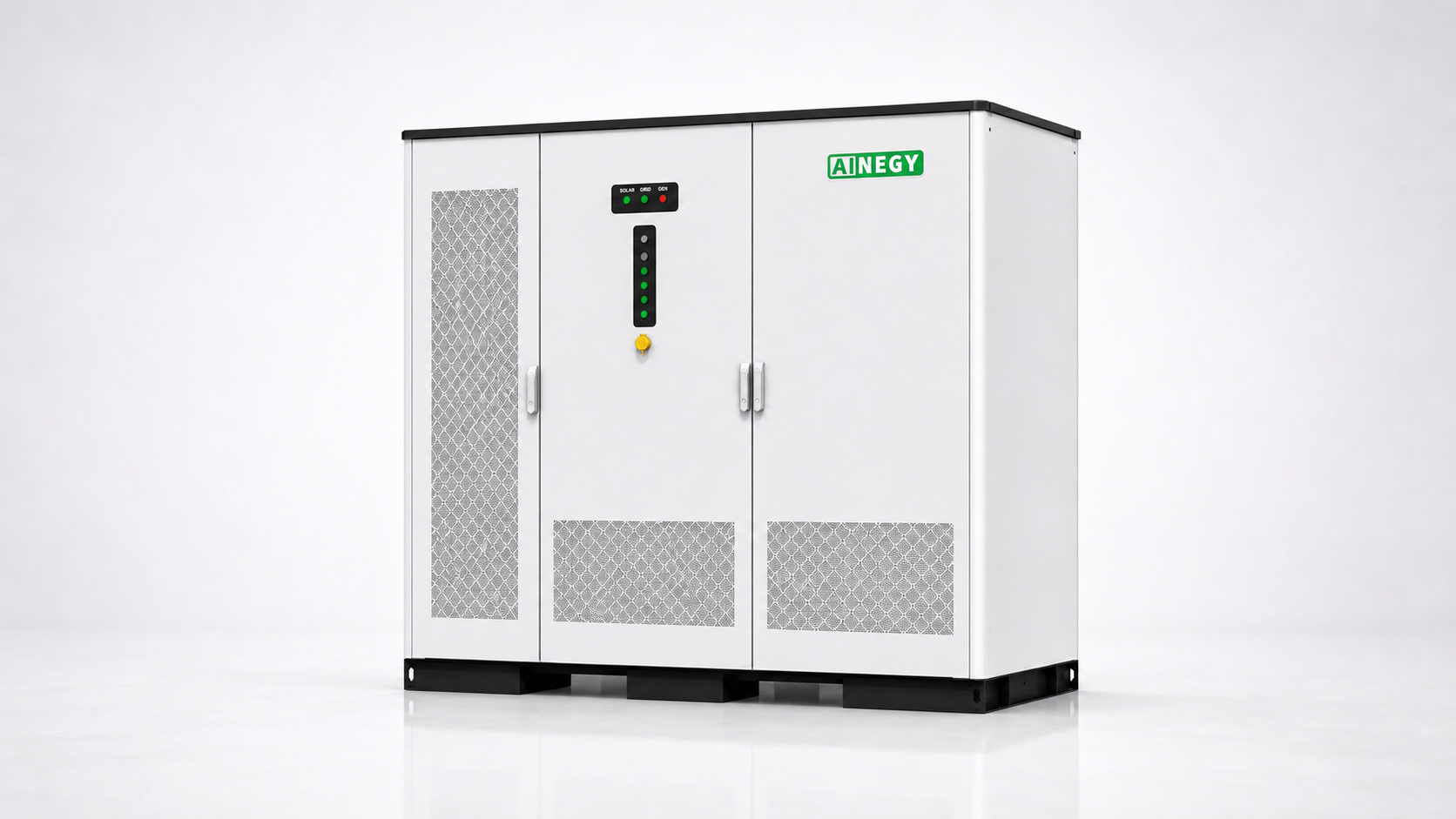
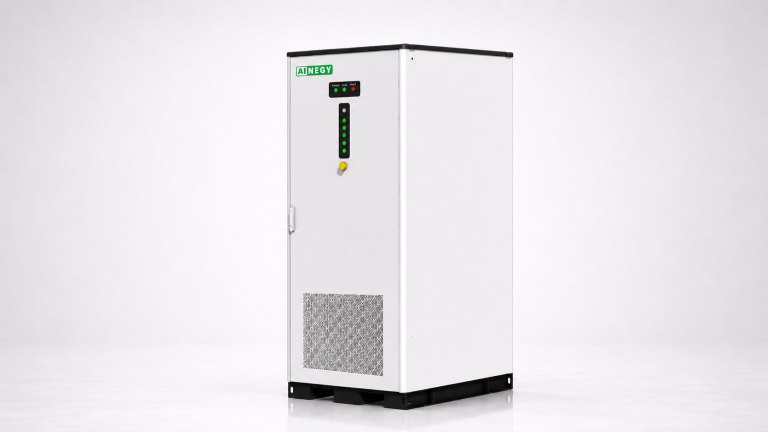
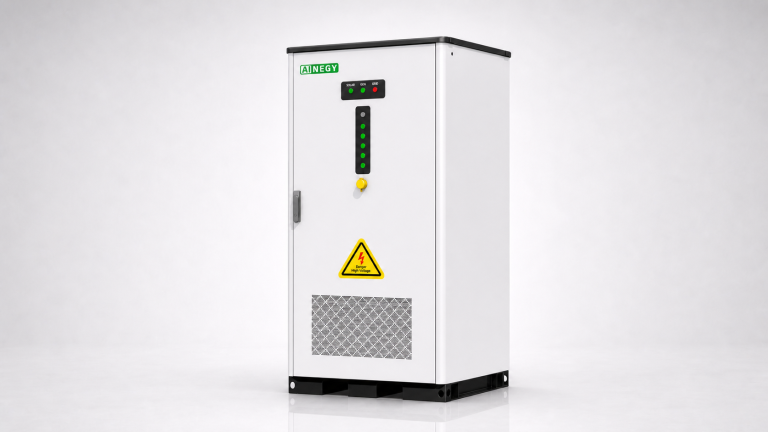
AINEGY Extended-Capacity Solar Diesel Hybrid Microgrid BESS Cabinet / Liquid Cooling
A 250kW/522kWh liquid-cooled hybrid microgrid BESS cabinet with larger battery reserve, expert-level EMS and integrated ATS for C&I projects requiring PV, battery, grid and diesel generator coordination.
The AINEGY extended-capacity platform integrates LiFePO4 battery storage, BMS, PCS, 240kW PV MPPT input, expert-level EMS, integrated ATS, diesel generator port, fire protection and communication architecture in one cabinet. It is designed to dynamically coordinate solar power, battery energy, grid supply, generator-supported recharge and critical loads in real time.
What Makes It an Extended-Capacity AINEGY Microgrid BESS Cabinet?
This product is not a generic 250kW battery cabinet. It is an extended-capacity solar-diesel hybrid microgrid BESS cabinet that combines a 250kW PCS platform with a 522kWh LiFePO4 battery reserve, expert-level EMS, integrated ATS, PV MPPT input and diesel generator port.
The 522kWh battery reserve is the main difference from compact 261kWh high-power cabinets. It gives the same 250kW platform more stored energy for C&I microgrid operation.
Extended Capacity, Not Generic Long-Duration Storage
Professional buyers distinguish between power capacity and energy capacity. This cabinet provides 250kW rated power and 522kWh battery reserve. It is best positioned as an extended-capacity microgrid BESS cabinet because it offers larger stored energy than the 261kWh version while still remaining a compact cabinet-level C&I platform.
AINEGY Expert-Level EMS: The Control Brain of the Hybrid Microgrid Cabinet
AINEGY’s EMS is not only a monitoring layer. It is the control brain that observes system status and dynamically coordinates solar power, battery energy, grid supply, diesel generator support, integrated ATS and critical loads.
Real-Time Observation and Dynamic Multi-Source Control
The expert-level EMS monitors PV input, battery SOC, PCS output, grid status, diesel generator port, integrated ATS status and load demand in real time. It then coordinates energy flow between solar generation, stored battery energy, grid supply, generator-supported recharge and critical loads according to the project strategy.
Precise Dynamic Energy Interface Control
AINEGY EMS coordinates the key energy interfaces instead of leaving PV, battery, grid and generator to operate as disconnected equipment.
Real-Time System Observation
The system supports real-time observation of major operating states through EMS communication and field status indication.
Integrated Cabinet-Level Microgrid Platform
Battery, PCS, MPPT, expert EMS, integrated ATS, generator port, liquid cooling and communication are combined into one competitive AINEGY platform.
AINEGY Energy Coordination Logic for Extended-Capacity Hybrid Microgrids
A 250kW/522kWh solar diesel hybrid cabinet creates value when expert EMS, integrated ATS, PV input, battery reserve, generator support and critical-load strategy operate as one engineered system.
Use Available PV Before Fuel-Based Generation
Available solar energy can supply local demand or charge the 522kWh battery reserve, helping the project improve onsite renewable-energy utilization.
Provide a Larger Energy Buffer
The 522kWh battery reserve buffers PV fluctuation, supports longer critical-load operation and reduces the need for frequent generator-supported recharge.
Use Diesel Generation as a Coordinated Backup Resource
Diesel generator support is used when solar production and battery reserve cannot cover sustained demand under the configured EMS strategy.
Coordinate Source Transfer Inside the Cabinet Platform
Integrated ATS architecture helps coordinate grid, generator, BESS output and load-side source transfer within the microgrid operating logic.
Prioritize the Loads That Matter
Critical-load planning helps allocate stored energy and generator support to pumps, refrigeration, lighting, communication, process control or emergency loads.
Scale Energy Reserve and Project Capacity
Up to 6 cabinets can be engineered in parallel when larger project capacity and coordinated EMS operation are required.
AINEGY Engineering Behind the 250kW/522kWh Cabinet
Product stability and competitiveness are supported by battery protection, expert EMS, integrated source transfer, bidirectional conversion, thermal control, safety response, communication visibility and manufacturing experience.
Years of BMS/EMS Technology Accumulation
AINEGY’s energy-storage platform is built around long-term development of battery-management and energy-management technologies.
R&D Team Members
AINEGY’s product development supports battery systems, EMS control, inverter technology and lithium battery processes.
Countries and Regions Reached
International project exposure supports adaptation to different grid, generator, voltage and environmental conditions.
Cumulative Battery Shipment
Manufacturing and delivery experience supports repeatable battery-system integration and international project execution.
Battery State Estimation and Multi-Layer Protection
The BMS platform supports cell monitoring, balancing, temperature and current supervision, SOC estimation, hierarchical management and coordinated fault response.
Real-Time Multi-Source Energy Control
EMS dynamically coordinates PV, battery, PCS, grid, generator, integrated ATS and critical loads according to real-time operating status.
Built-In Source Transfer Architecture
Integrated ATS supports coordinated source-transfer logic between grid, generator, BESS output and load-side microgrid operation.
Bidirectional Microgrid Power Conversion
The 250kW PCS platform controls charging and discharging between the high-voltage battery and the 400Vac/230Vac three-phase AC bus.
Thermal Support for a 522kWh High-Capacity Cabinet
Liquid cooling supports module temperature consistency and thermal behavior in a high-energy-density cabinet under variable C&I duty cycles.
RS485, Ethernet and 4G Communication
Multiple communication interfaces support local integration, remote operating visibility and connection to wider project monitoring architecture.
Microgrid Status Made Visible in the Field
AINEGY T-Visual™ converts hybrid-energy operation into an immediate front-panel status language. Operators can identify solar, grid and generator source status, system run or fault condition and battery energy level without first navigating a multi-page monitoring interface.
Advantages of AINEGY Liquid Cooling for a 522kWh BESS Cabinet
For a 522kWh high-energy-density cabinet, thermal management is not only about reducing maximum battery temperature. AINEGY liquid cooling is designed to support module temperature consistency, reduce dependence on long cabinet airflow paths and improve thermal behavior during PV charging, 250kW discharge and generator-supported recharge.
| Engineering Consideration | Air-Cooled Cabinet | AINEGY Liquid-Cooled 522kWh Cabinet |
|---|---|---|
| Heat-transfer path | Uses conditioned airflow and cabinet air ducts to remove heat. | Uses circulating coolant and cold-plate paths positioned closer to battery-module heat sources. |
| Temperature uniformity | Depends strongly on airflow balance, filter condition, duct resistance and cabinet layout. | Better suited to controlling module-to-module temperature variation in a high-capacity battery arrangement. |
| Energy density | Requires sufficient air channels and heat-exchange space around battery racks. | Supports a denser 522kWh cabinet architecture without relying only on large internal airflow passages. |
| Hybrid microgrid duty | Suitable where charge/discharge intensity, ambient temperature and cycling duty are moderate. | More appropriate for PV charging, 250kW discharge, SOC recovery and generator-assisted recharge cycles. |
| Project economics | Lower initial complexity and cost; suitable for lower-duty or budget-sensitive projects. | Higher thermal-system complexity, justified where larger battery reserve, temperature consistency and operational stability have greater project value. |
Thermal Consistency Matters
High-capacity stationary BESS operation requires attention to module temperature consistency, not only the hottest single point.
Reduced Dependence on Cabinet Airflow
Liquid cooling reduces reliance on long airflow channels through a densely populated cabinet, where resistance and recirculation can create uneven conditions.
Designed for C&I Microgrid Duty
The thermal architecture supports changing heat loads caused by PV charging, 250kW discharge, generator-assisted recharge and outdoor site conditions.
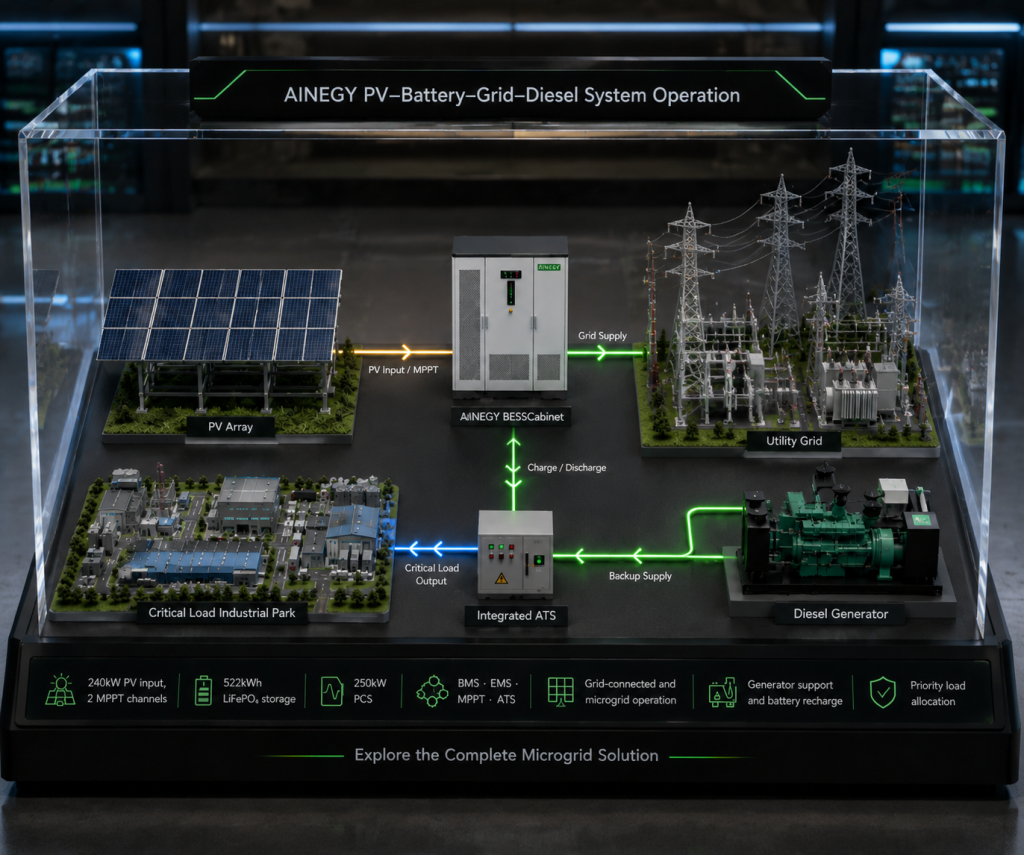
AINEGY PV–Battery–Grid–Diesel System Operation
The cabinet connects PV generation, battery storage, PCS output, expert EMS control, integrated ATS, utility grid, diesel generator port and critical loads. The AINEGY cabinet supplies the energy-storage, conversion, solar-input and source-transfer core for the hybrid microgrid system.
Problems the AINEGY Extended-Capacity Microgrid BESS Cabinet Helps Solve
The AINEGY 250kW/522kWh liquid-cooled cabinet is designed for C&I and remote power projects where larger energy reserve, PV utilization, generator-supported recharge and critical-load operation must be coordinated by one expert EMS platform.
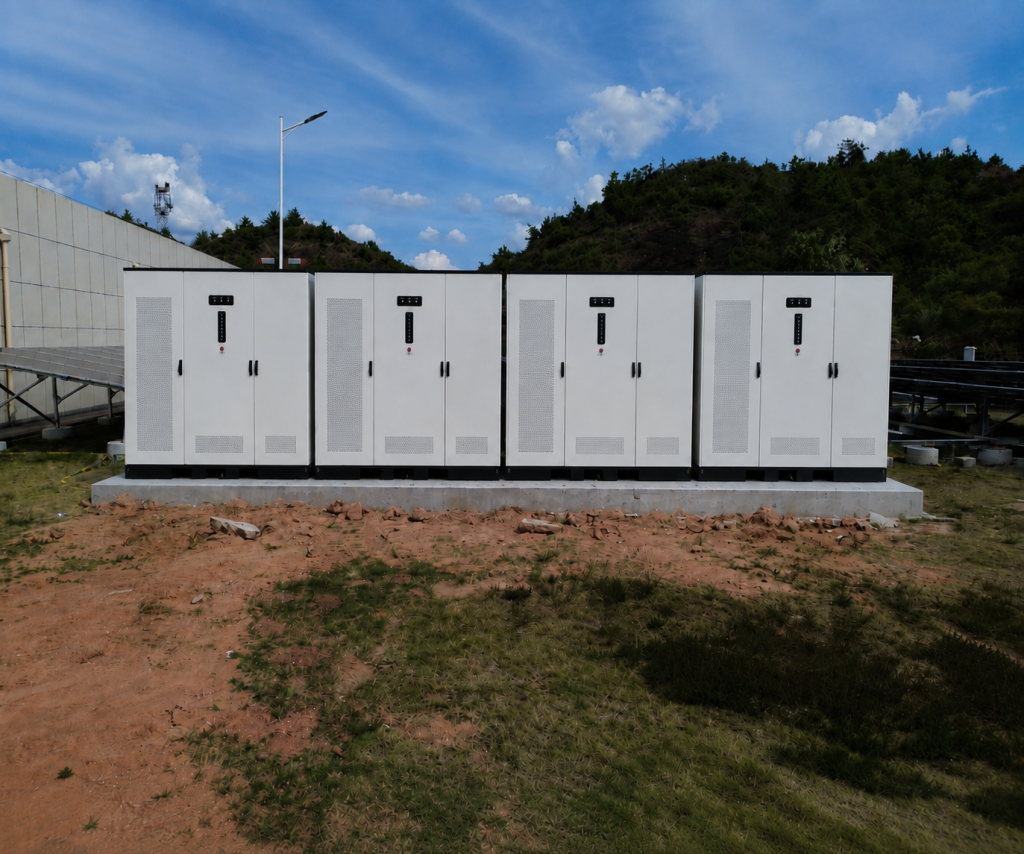
From Longer Support Requirement to Microgrid Configuration
AINEGY helps project owners and EPCs move from simple equipment selection to complete microgrid configuration logic: PV capacity, generator power, battery reserve, critical-load duration, motor starting demand, integrated ATS logic, site temperature, communication and future expansion are evaluated together.
Reduce Frequent Generator Dependence
AINEGY extended-capacity BESS stores solar energy and provides a larger battery reserve for remote sites where fuel transport is expensive and supply continuity matters.
Support Longer Critical-Load Operation
Pumps, refrigeration, lighting, POS, monitoring and communication systems need sustained support during grid instability or outages.
Coordinate PV, Battery and Industrial Demand
AINEGY configuration considers PV generation, electric motors, pumps, compressors, power factor, peak load and generator support as one microgrid problem.
AINEGY 250kW/522kWh Extended-Capacity Technical Specifications
Model IYP-B522L-250H3S-240M2-HX1 combines a 522kWh high-voltage LiFePO4 battery system, 250kW PCS architecture, 240kW PV input, expert-level EMS and integrated ATS within a liquid-cooled cabinet.
| Item | Specification |
|---|---|
| Product | AINEGY Extended-Capacity Solar Diesel Hybrid Microgrid BESS Cabinet / Liquid Cooling |
| Model | IYP-B522L-250H3S-240M2-HX1 |
| Battery System | |
| Battery Chemistry | LiFePO4 |
| Rated Energy | 522kWh |
| Nominal Voltage | 832V |
| Rated Capacity | 628Ah |
| Battery Cooling | Liquid cooling |
| PV Input | |
| Maximum PV Power | 240kW, 2 channels |
| Maximum PV Voltage | 950Vdc |
| MPPT Voltage Range | 250–850Vdc |
| Maximum PV Input Current | 200A + 200A |
| MPPT Channels | 2 |
| AC On-grid | |
| Rated Power | 250kW |
| AC Voltage | 400Vac / 230Vac, L1 / L2 / L3 / N / PE |
| Rated Frequency | 50Hz / 60Hz |
| Maximum AC Current | 375A |
| AC Off-grid | |
| Rated Power | 250kW |
| AC Voltage | 400Vac / 230Vac, L1 / L2 / L3 / N / PE |
| Rated Frequency | 50Hz / 60Hz |
| Maximum AC Current | 375A |
| On/Off-grid Switching Time | <20ms |
| Maximum Parallel Quantity | 6 units |
| Microgrid Interfaces and General Data | |
| Expert-Level EMS | Real-time observation and dynamic control of PV, battery, PCS, grid, diesel generator port, integrated ATS and load-side energy flow |
| ATS Architecture | Integrated ATS |
| Diesel Generator Port | Yes |
| Communication | RS485 / Ethernet / 4G |
| Battery Protection Rating | IP65 |
| Fire Protection System | Yes |
| Operating Temperature | -10°C to 55°C |
| Relative Humidity | 5% to 95% |
| Altitude | <2000m |
| PCS Cooling | Intelligent cooling |
| Dimensions | 2570 × 1370 × 2050mm |
| Approximate Weight | About 4900kg |
Load Data Required
- Hourly load curve and maximum simultaneous demand
- Motor, pump and compressor starting current
- Power factor and reactive-power demand
- Critical and non-critical load separation
PV Array Data Required
- 240kW PV configuration target
- Module Voc and temperature coefficient
- String operating voltage
- Maximum input current within MPPT limits
Generator Data Required
- Generator rated and standby power
- Minimum stable generator loading
- Overload and step-load response
- Controller communication or start-stop interface
Project Integration Data
- Single-line diagram and grounding arrangement
- Critical-load bus and source-transfer strategy
- Ambient temperature and altitude
- Communication and remote-monitoring protocol
Engineering FAQ and RFQ Readiness
These answers help EPCs, distributors and C&I project owners prepare accurate technical requirements before requesting an AINEGY extended-capacity microgrid quotation.
The main difference is energy reserve. Both platforms use 250kW rated power, but this model uses 522kWh battery capacity, giving the project more stored energy for PV buffering, SOC reserve and critical-load support.
AINEGY EMS observes PV input, battery SOC, PCS output, grid status, generator port, integrated ATS and load demand in real time. It dynamically coordinates solar charging, battery discharge, grid supply, generator-supported recharge and critical-load support according to the configured project strategy.
Yes. This AINEGY solar-diesel hybrid microgrid cabinet uses integrated ATS architecture, supporting coordinated source transfer between grid, diesel generator, BESS output and load-side microgrid operation.
Choose 522kWh when the project needs a larger energy buffer, longer critical-load support, stronger PV fluctuation buffering or less frequent generator-supported recharge than a compact 261kWh cabinet can provide.
The product is designed for coordinated PV, battery, grid and diesel generator operation, not unconditional diesel replacement. It can reduce unnecessary generator runtime in properly configured projects, while generator support remains valuable for sustained low-solar or high-load periods.
Motor starting must be checked before selection. Provide locked-rotor current, starting duration, soft-start or VFD information, power factor, simultaneous starting sequence and acceptable voltage deviation.
Parallel projects require synchronized PCS control, expert EMS coordination, AC bus and breaker sizing, protection selectivity, cable-impedance review, SOC alignment and a controlled commissioning sequence.
Send the single-line diagram, PV module and string data, generator specification, hourly load profile, motor-starting information, critical-load list, backup-duration target, ambient temperature, altitude, communication protocol and expected expansion plan.
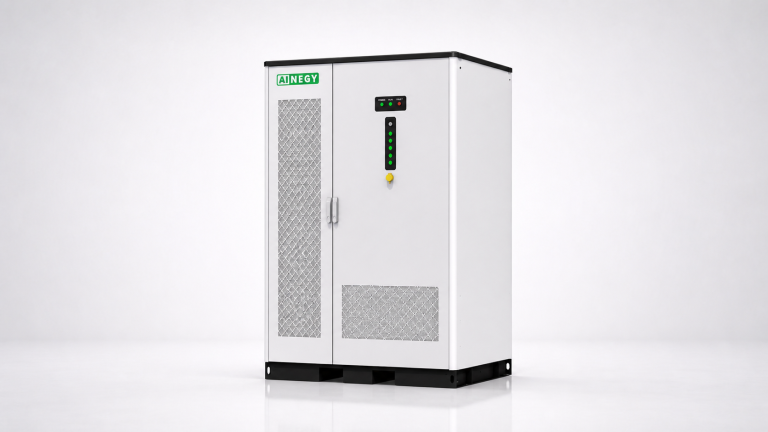
Configure Your Extended-Capacity Microgrid Project with AINEGY
Send your PV data, generator specification, load curve, motor-starting data, critical-load list, required backup duration, communication protocol and site conditions. AINEGY will use these inputs to evaluate 250kW output, 522kWh battery reserve, 240kW PV input, expert EMS strategy, integrated ATS operation and parallel expansion requirements.