
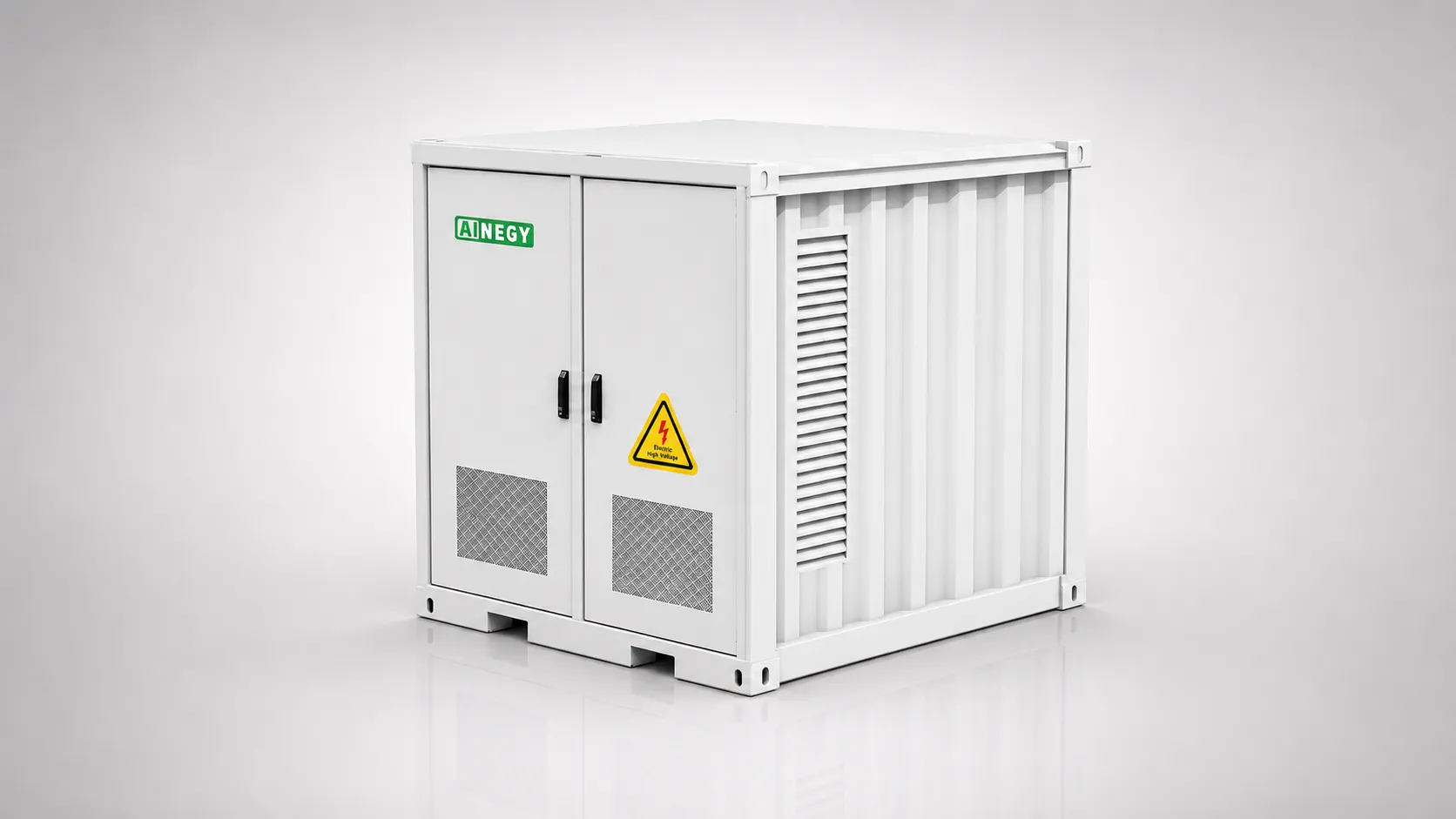
AINEGY 250kW/522kWh Solar-Diesel Hybrid Microgrid BESS Container
A compact liquid-cooled BESS container engineered to coordinate solar power, battery storage, grid supply and diesel generation for remote, weak-grid and mission-critical C&I sites.
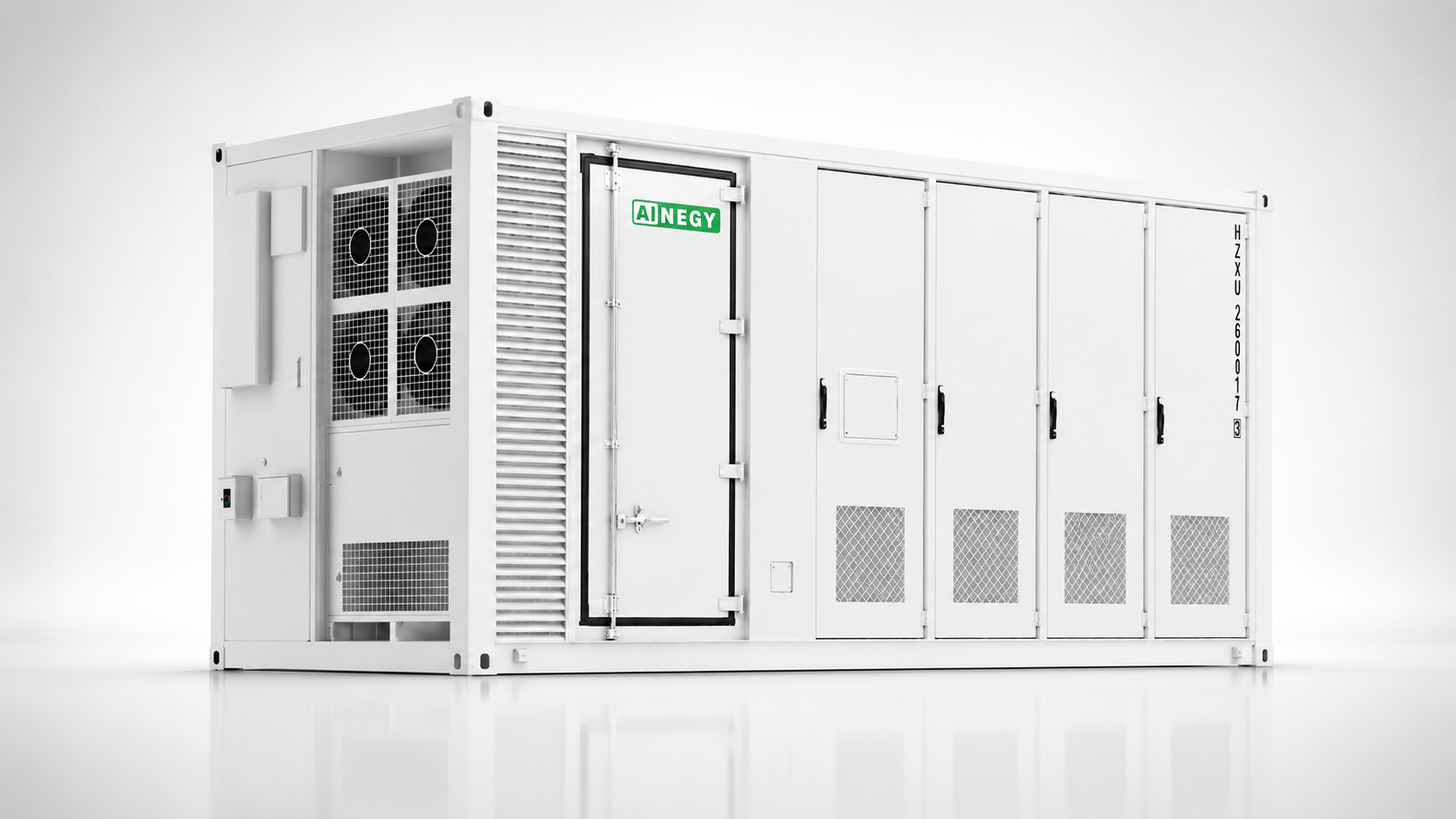
The AINEGY 250kW/522kWh Solar-Diesel Hybrid Microgrid BESS Container brings LiFePO4 battery storage, PCS, MPPT, expert EMS, integrated ATS, generator interface, fire protection, liquid cooling and communication into one transportable containerized system.
Built as a Compact Hybrid Microgrid Power Core
The AINEGY 250kW/522kWh BESS Container is designed for projects that need more than standby batteries. It combines solar input, battery reserve, power conversion, source switching and generator support into one compact platform for controlled hybrid power.
Use Available PV Before Fuel-Based Generation
PV energy can support loads or charge the battery reserve, reducing unnecessary generator operation when solar conditions allow.
Keep Diesel as a Managed Support Source
The generator port supports sustained demand, low-solar periods and battery recharge under the configured EMS strategy.
Coordinate Grid, Generator, BESS and Loads
Built-in ATS architecture supports controlled source transfer for hybrid microgrid operation.
Compact Container Format for Distributed Sites
The 8ft-class structure supports remote, distributed and space-sensitive C&I energy storage projects.
AINEGY Engineering and Quality Support
AINEGY’s containerized hybrid energy storage platform is supported by BMS/EMS development, inverter technology, lithium battery integration, system manufacturing, factory testing and international project delivery experience.
Years of BMS/EMS Technology Accumulation
Long-term development of battery-management and energy-management technologies for lithium battery storage systems.
R&D Team Members
Engineering support for BMS, EMS, inverter technology, battery integration and customized storage systems.
Countries and Regions
Project exposure across different grid, generator, voltage, communication and environmental conditions.
Cumulative Battery Shipment
Manufacturing and delivery experience for repeatable energy storage integration and international execution.
Integrated Before Delivery
Battery system, PCS, MPPT, EMS, ATS, generator interface, cooling, fire protection and communication are integrated as one platform.
Factory Testing for Hybrid Operation
Testing covers battery system, PCS, EMS, MPPT, communication, source switching, protection response and generator interface checks.
Configured by Site Conditions
Final configuration reviews load curve, PV design, generator size, critical loads, transport conditions, altitude and installation environment.
AINEGY 250kW/522kWh BESS Container Technical Specifications
Model IYP-CB522L-250H3S-240M2-HX1 integrates 522kWh LiFePO4 battery storage, 250kW AC power conversion, 240kW PV input, expert EMS, integrated ATS and diesel generator interface in a compact liquid-cooled container structure.
| Item | Specification |
|---|---|
| Product | AINEGY 250kW/522kWh Solar-Diesel Hybrid Microgrid BESS Container / Liquid Cooling |
| Model | IYP-CB522L-250H3S-240M2-HX1 |
| Battery System | |
| Battery Chemistry | LiFePO4 Battery |
| Rated Energy | 522kWh |
| Battery Cooling Method | Liquid cooling |
| PV Input | |
| Maximum PV Power | 240kW, 2 channels |
| Maximum PV Voltage | 950Vdc |
| MPPT Voltage Range | 250–850Vdc |
| Maximum PV Input Current | 200A + 200A |
| MPPT Channels | 2 |
| AC On-grid | |
| Rated Power | 250kW |
| AC Voltage | 400Vac / 230Vac, L1 / L2 / L3 / N / PE |
| Rated Frequency | 50Hz / 60Hz |
| Maximum AC Current | 375A |
| AC Off-grid | |
| Rated Power | 250kW |
| AC Voltage | 400Vac / 230Vac, L1 / L2 / L3 / N / PE |
| Rated Frequency | 50Hz / 60Hz |
| Maximum AC Current | 375A |
| On/Off-grid Switching Time | <20ms |
| Maximum Parallel Quantity | 3 units |
| Microgrid Interfaces and General Data | |
| Integrated Architecture | LiFePO4 Battery / BMS / PCS / Expert EMS / MPPT / Integrated ATS / Generator Port |
| Diesel Generator Port | Yes |
| Communication Type | RS485 / Ethernet / 4G |
| Battery Protection Rating | IP65 |
| Fire Protection System | Yes |
| Operating Temperature | -10°C to 50°C |
| Relative Humidity | 5% to 95% |
| Altitude | <3000m |
| PCS Cooling Method | Intelligent cooling |
| Transport Compatibility | Compatible with standard 20ft high-cube container for transportation |
| Dimensions | 2500 × 2200 × 2200mm |
| Approximate Weight | About 5500kg |
Project Data Required
- Hourly load curve and maximum simultaneous demand
- Critical and non-critical load separation
- Required backup duration and SOC reserve
- Installation layout, altitude and ambient temperature
PV and Generator Checks
- PV string voltage within 250–850Vdc MPPT range
- Maximum PV voltage below 950Vdc
- Generator rated power and minimum stable load
- Generator controller and start-stop interface
Load Checks
- Motor, pump and compressor starting current
- Power factor and reactive-power demand
- Three-phase balance and load sequencing
- Breaker, cable and protection selectivity
From Diesel-Dependent Site to Solar-First Hybrid Microgrid
For remote industrial, commercial backup and weak-grid projects, the value is not simply storing electricity. The value is giving the site a controlled energy strategy across PV, battery, grid and diesel generation.
Use Solar Energy Before Fuel Where Possible
Available PV can serve local loads or charge the battery reserve, helping reduce unnecessary generator operation under suitable project conditions.
Stabilize Solar Variability and Short Peaks
The 522kWh battery reserve provides a buffer between variable PV output, short load peaks and generator-backed recharge.
Use Diesel as a Managed Energy Source
Diesel generation can support sustained demand, low-solar periods and battery recovery instead of running as the only daily power source.
Coordinate Grid, Generator and BESS Output
Integrated ATS architecture supports controlled source transfer for grid-connected and off-grid microgrid operation.
Focus Stored Energy Where It Matters
Pumps, refrigeration, communications, lighting, controls, HVAC support and safety loads can be prioritized by project design.
Scale the Site When Demand Expands
Up to 3 containers can be engineered in parallel when energy reserve, peak power or PV charging strategy requires expansion.
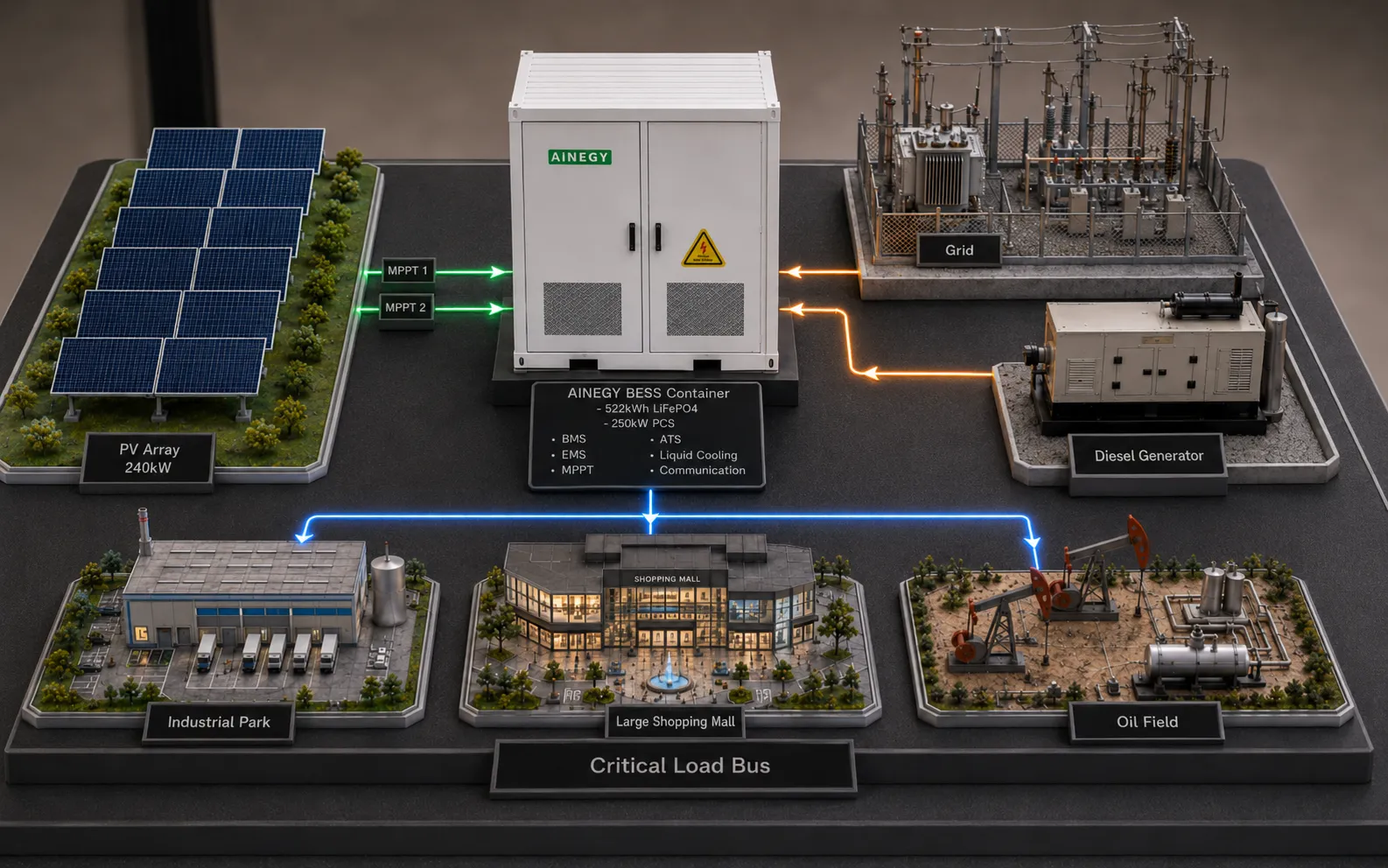
PV–Battery–Grid–Diesel System Operation
The AINEGY container connects PV generation, LiFePO4 battery storage, PCS output, expert EMS control, integrated ATS, utility grid, diesel generator port and critical loads. It is designed as the source coordination core for remote, weak-grid and diesel-dependent C&I microgrids.
AINEGY Expert EMS + Integrated ATS
The strongest value is not simply battery capacity. It is the ability to observe, judge and dynamically coordinate PV, battery, PCS, grid, generator, ATS and critical loads as one power system.
Real-Time Source Coordination
AINEGY Expert EMS continuously reads PV input, battery SOC, PCS output, grid status, generator status, ATS position and load demand. Integrated ATS supports controlled source transfer between grid, generator, BESS output and the load-side microgrid.
Application Scenarios for AINEGY 250kW/522kWh Solar-Diesel Hybrid Microgrid BESS Container
Designed for remote and weak-grid projects where fuel logistics, unstable grids, critical loads and deployment speed directly affect project economics.
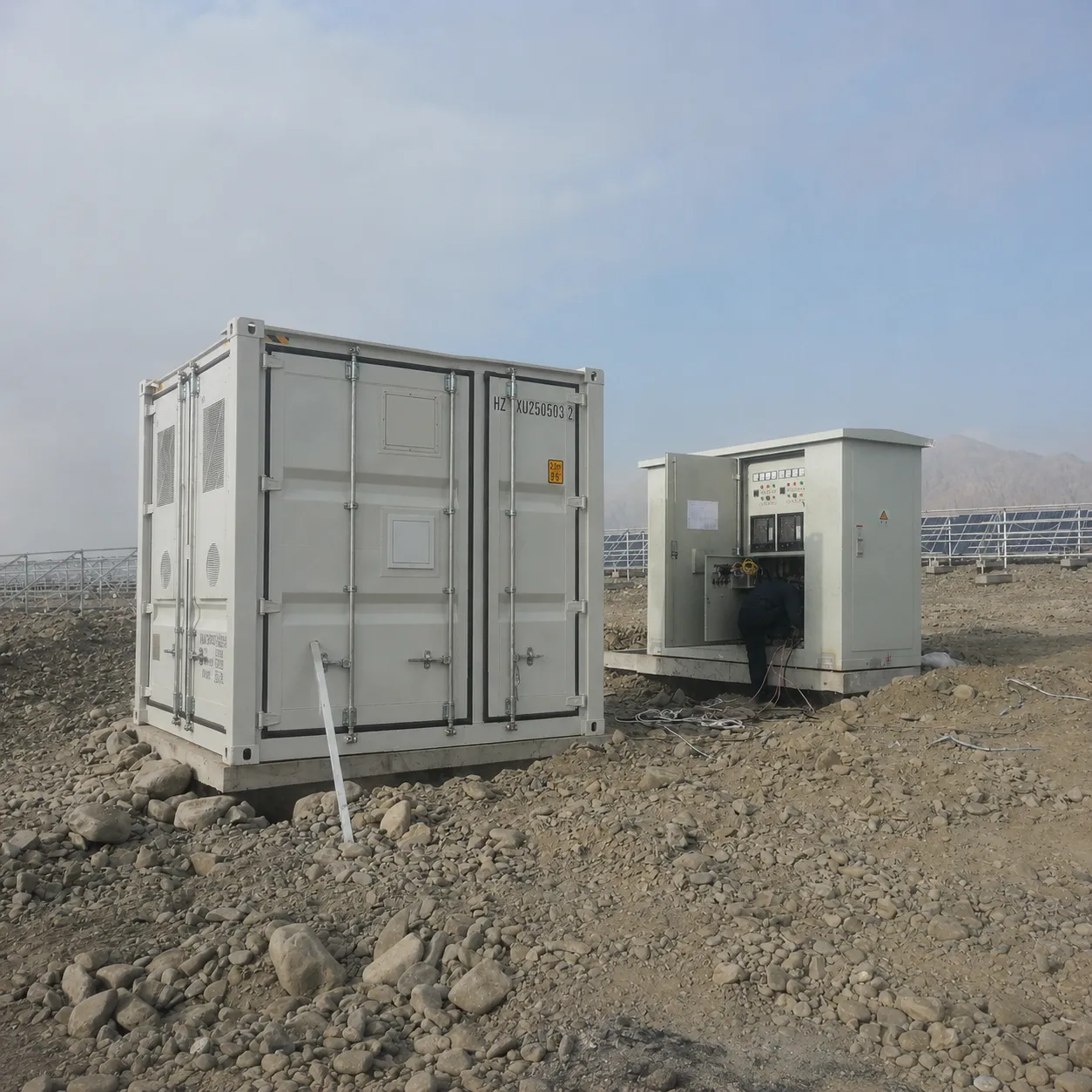
Hybrid Power for Remote Energy Operations
Remote oil and gas sites depend on reliable power for pumps, monitoring, communications, lighting and camp loads.
AINEGY combines PV input, battery reserve and generator-backed support to reduce diesel dependence while keeping operating power available.
Containerized PV-Battery-Diesel Supply
Mining sites often face weak grids, high fuel logistics cost and demanding loads such as pumps, ventilation, lighting and control systems.
The 250kW/522kWh container provides a compact hybrid power core for selected industrial loads and generator-supported operation.
Reduce Diesel-Only Dependence
Island and remote community projects face fuel transport cost, grid instability and long daily operating hours.
AINEGY provides PV buffering, battery reserve and generator-backed supply in a compact containerized format.
Transportable Temporary Power
Temporary worksites and project camps need flexible power systems that can move with project stages.
The 8ft-class structure and 20ft HC transport compatibility support faster deployment and relocation planning.
Commercial Critical-Load Backup
Gas stations, supermarkets and cold-chain sites depend on pumps, POS systems, refrigeration, lighting and communication systems.
The 522kWh battery reserve and generator support help protect revenue-critical operations during unstable power conditions.
PV-Diesel-Battery Energy Buffer
Solar generation projects often need storage to buffer PV fluctuation, shift energy use and support weak-grid operation.
With 240kW PV input and hybrid dispatch capability, the container helps turn solar power into a more controllable energy resource.
Engineering FAQ and RFQ Readiness
These questions reflect real project selection issues: diesel runtime, PV sizing, motor starting, generator strategy, integrated ATS operation, parallel expansion and critical-load duration.
Yes, when properly sized. PV can serve loads or charge the battery, the 522kWh reserve can handle short-duration peaks and low-solar gaps, and the generator can operate as a managed backup or recharge source.
The EMS observes PV input, battery SOC, PCS output, grid condition, generator status, ATS position and load demand, then follows the configured strategy for PV priority, SOC reserve, generator recharge and critical-load support.
Motor starting must be checked before selection. Provide locked-rotor current, soft-start or VFD configuration, starting duration, power factor, simultaneous starting sequence and acceptable voltage deviation.
Runtime depends on usable battery energy, SOC reserve, load level, PV availability and generator strategy. A 50kW priority load behaves very differently from a 200kW priority load.
Parallel operation should be considered when total power demand, battery reserve, PV charging strategy or critical-load duration exceeds one container. Parallel design requires AC bus sizing, protection selectivity and EMS coordination.
It can support facility-level backup loads such as emergency lighting, HVAC assistance, refrigeration, communications and defined critical infrastructure when integrated with compliant hospital electrical systems, UPS equipment and generators.
Matching should be based on daytime load, PV generation profile, battery SOC reserve, generator minimum loading, recharge target, backup duration and fuel strategy.
Send the single-line diagram, PV module and string data, generator specification, hourly load profile, motor-starting data, critical-load list, backup-duration target, ambient temperature, altitude, communication protocol and site layout.
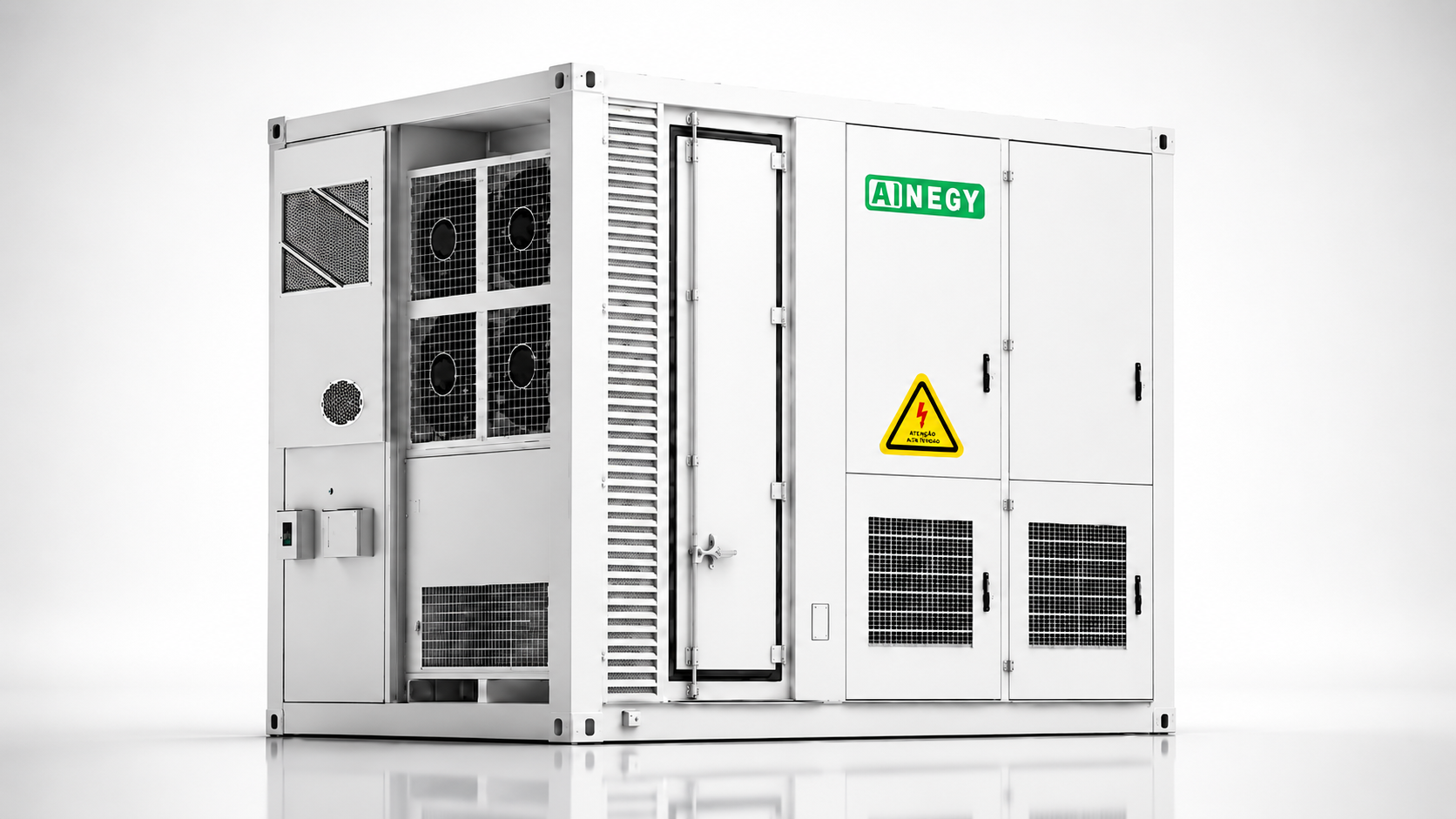
Configure Your 250kW/522kWh Hybrid Microgrid Container with AINEGY
Send your PV data, generator specification, load curve, motor-starting data, critical-load list, site layout, required backup duration and transport conditions. AINEGY will evaluate the 250kW output, 522kWh battery reserve, 240kW PV input, expert EMS strategy, integrated ATS operation and parallel expansion requirements.