AINEGY Logo
51.2V Rack Mount Battery for Solar Storage and Backup Power

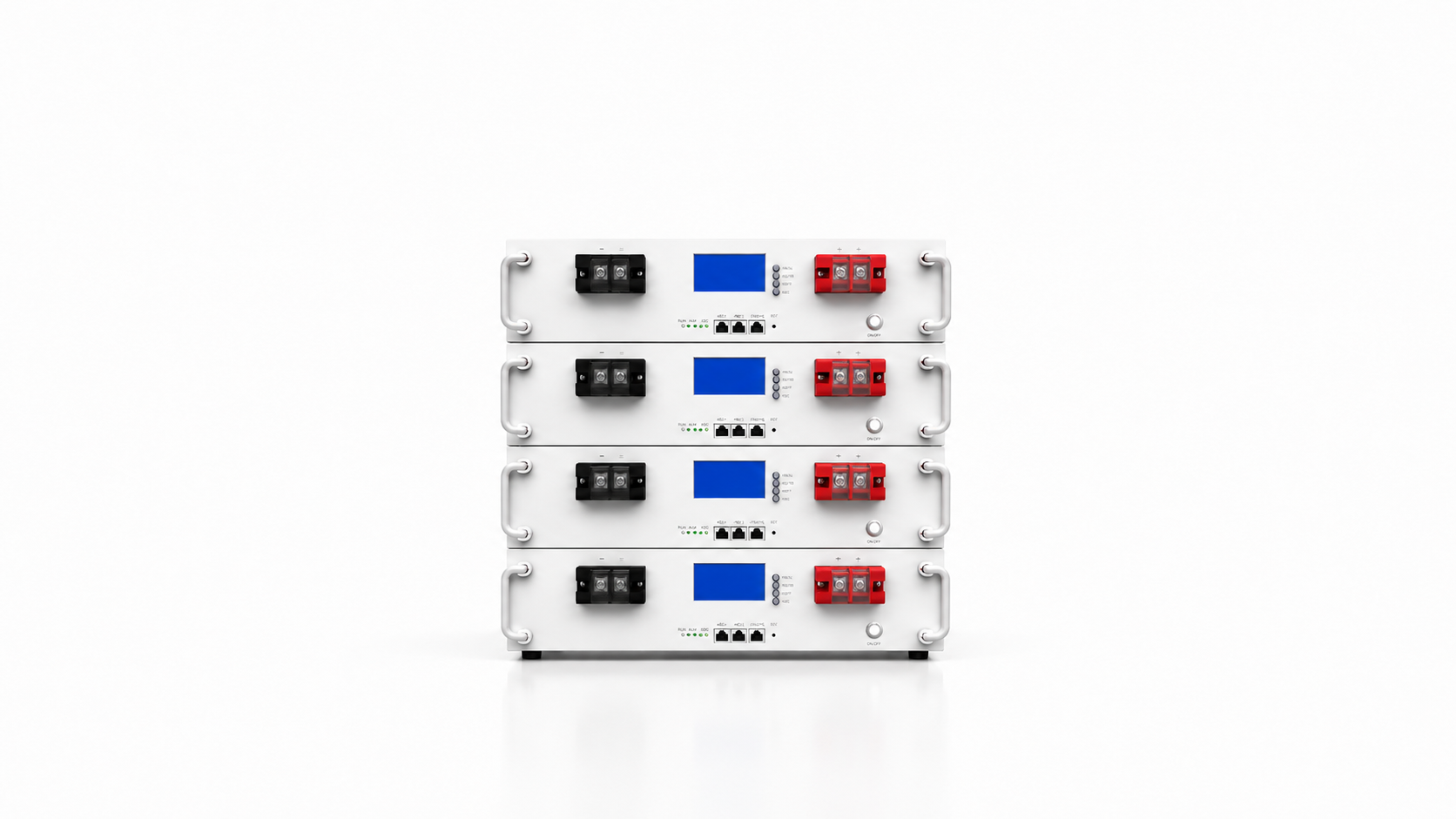
Rack-Mounted LiFePO4Battery

51.2V rack mount LiFePO4 battery series for solar battery storage, rack mount battery backup, off-grid systems, telecom backup and expandable 48V battery rack installations.

AINEGY Rack-Mounted LiFePO4 Battery is designed for rack-based and cabinet-based energy storage systems that need modular battery installation, expandable capacity, inverter communication matching and reliable BMS protection. The series supports self-developed BMS, communication protocol customization, up to 15 units in parallel and 15 layers of protection for residential, off-grid, telecom and small commercial backup power projects.
Rack-mounted LiFePO4 battery for 51.2V solar storage, rack mount battery backup and expandable battery rack systems
51.2V Platform48V-class battery platform for solar inverter and backup systems.
Max. 15 ParallelExpandable rack battery bank design for higher capacity.
15 ProtectionsSystem-level protection design with self-developed BMS.

Core Advantages of Rack Mount LiFePO4 Battery

Rack-mounted batteries are selected for structured installation, modular expansion, easier maintenance and system integration. This page focuses on 51.2V rack battery modules for solar storage, backup power, telecom backup and off-grid battery rack applications.

Advantage 01

Rack-Based Modular Installation

Designed for rack, cabinet and battery bank installation, making it easier to organize multiple battery modules in one structured system.

Advantage 02

51.2V / 48V Inverter Platform

51.2V battery platform is suitable for mainstream 48V solar inverter, backup power and off-grid energy storage systems.

Advantage 03

Max. 15 Units in Parallel

Supports up to 15 battery units in parallel for expandable capacity, subject to inverter, BMS communication and system configuration.

Advantage 04

Self-Developed BMS

Self-developed BMS supports battery monitoring, protection logic, communication management and system-level operation control.

Advantage 05

Communication Protocol Customization

Communication protocol customization helps match different inverter, backup and energy storage system requirements.

Advantage 06

15 Layers of Protection

15 layers of protection support safer battery operation for residential storage, off-grid, telecom and backup power projects.

Rack-Mounted LiFePO4 Battery Series

AINEGY rack battery products are organized by capacity range and installation form. Both series use a 51.2V battery platform for 48V-class solar storage, rack mount battery backup and expandable battery rack systems.
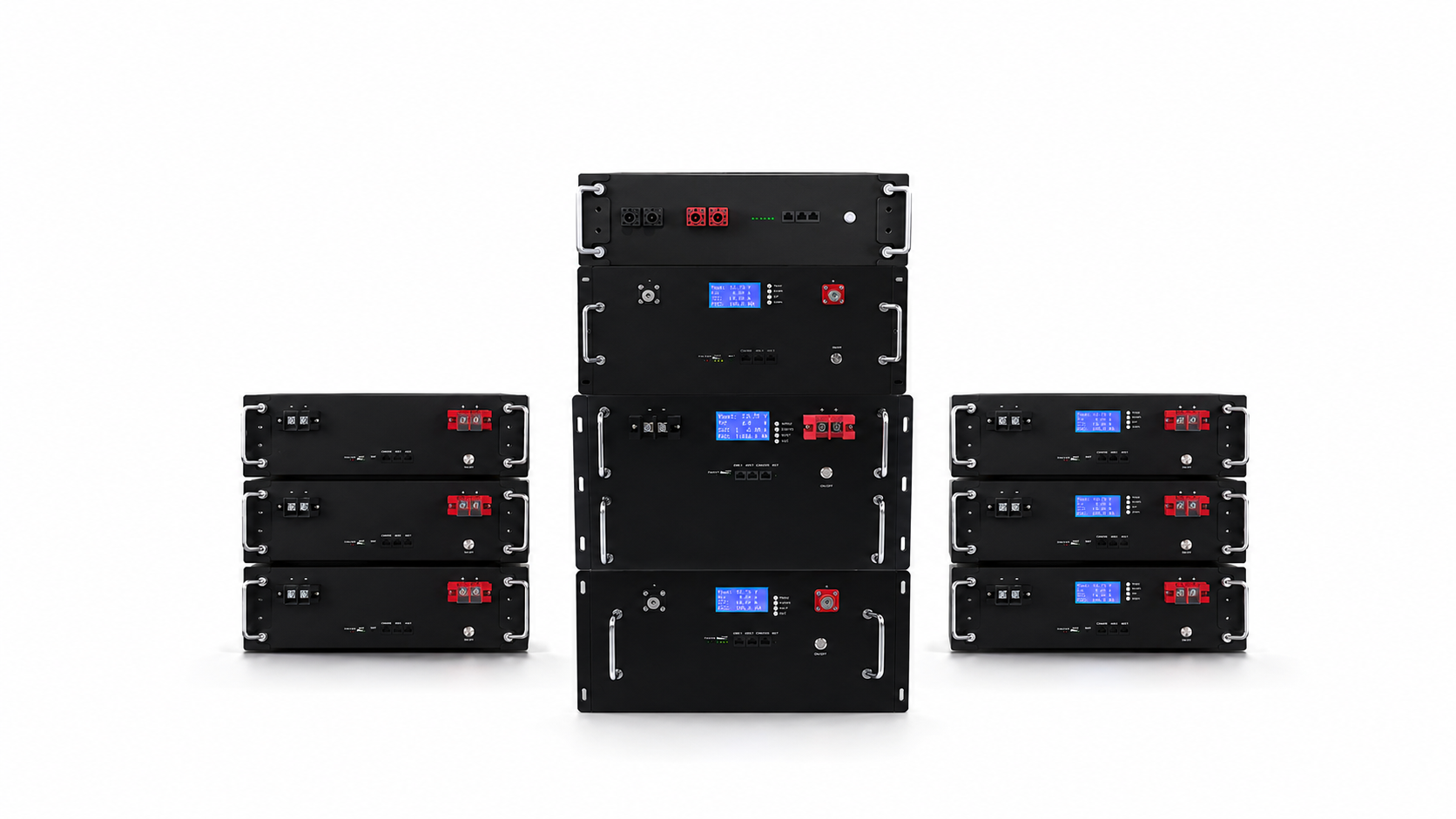
51.2V rack mount LiFePO4 battery series with 100Ah, 206Ah and 314Ah for solar storage and backup power

51.2V Rack Mount LiFePO4 Battery Series

51.2V 100Ah · 206Ah · 314Ah

Standard rack mount LiFePO4 battery series for residential solar storage, rack battery backup, telecom backup, off-grid systems, equipment rooms and expandable battery cabinet installations.

51.2V Platform100Ah / 206Ah / 314AhSelf-Developed BMSMax. 15 Parallel15 Protections
View Product Details
High-capacity rack-mounted LiFePO4 battery series with 51.2V 100Ah, 200Ah, 300Ah and 400Ah modules

51.2V High-Capacity Rack Mount LiFePO4 Battery Series

51.2V 100Ah · 200Ah · 300Ah · 400Ah

High-capacity rack-mounted LiFePO4 battery series for larger battery banks, longer backup duration, off-grid solar systems, small commercial backup and project-level energy storage installations.

High Capacity100Ah / 200Ah / 300Ah / 400AhRack Battery BankProtocol CustomizationMax. 15 Parallel
View Product Details

Rack-Mounted Battery or Wall-Mounted Battery?

Rack-mounted batteries and wall-mounted batteries are both used for energy storage, but they serve different installation logic. Rack-mounted batteries are better for cabinet-based systems, multiple modules, equipment rooms and integrated backup power projects.

Choose Rack-MountedFor battery racks, equipment rooms, telecom backup, battery cabinets and expandable module systems.
Choose Wall-MountedFor clean home installation where wall space, appearance and compact design are more important.
System IntegrationRack batteries are easier to organize in multiple-module systems with structured wiring and cabinet layout.
Maintenance AccessRack-based layout can make battery inspection, replacement and system expansion more convenient.

51.2V Platform for 48V Inverter Systems

Most low-voltage residential solar and backup systems use a 48V-class battery platform. A 51.2V LiFePO4 rack battery is commonly selected for 48V inverter systems, off-grid solar systems and rack mount battery backup installations.
48V-Class System Matching51.2V battery modules are suitable for many 48V-class solar inverter and backup power systems.
Solar Storage UseStore solar energy and discharge it for home, off-grid, telecom or backup load applications.
Rack Battery BackupWorks as a modular battery backup solution when matched with inverter, charger or power system.
Compatibility ReviewVoltage, communication, charge current and inverter settings should be confirmed before final selection.
Do not mix battery platforms, communication protocols or battery models without system-level review. Final matching depends on inverter brand, model, firmware and wiring design.
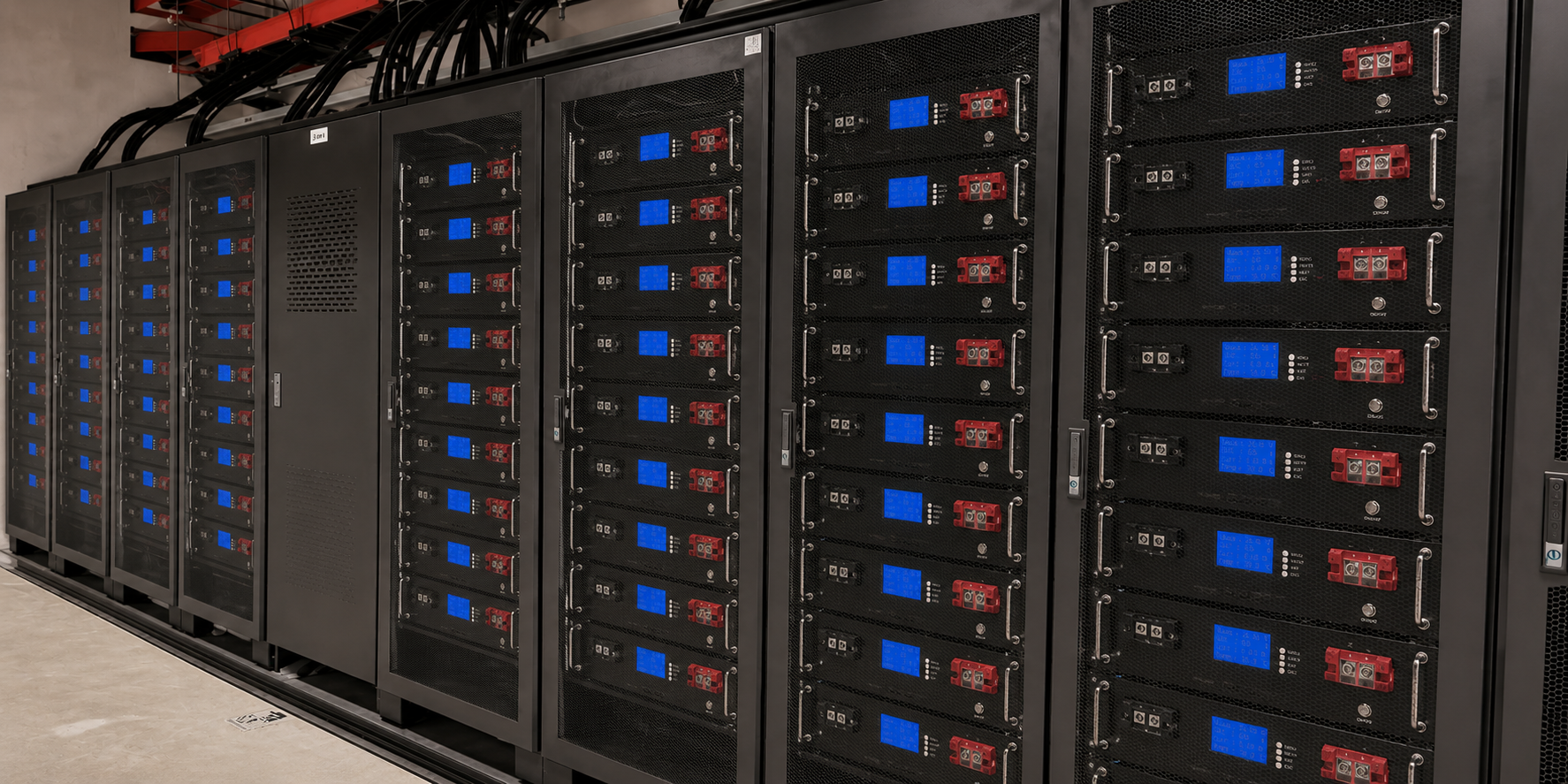
Rack mount LiFePO4 battery parallel expansion with battery cabinet and up to 15 units in parallel

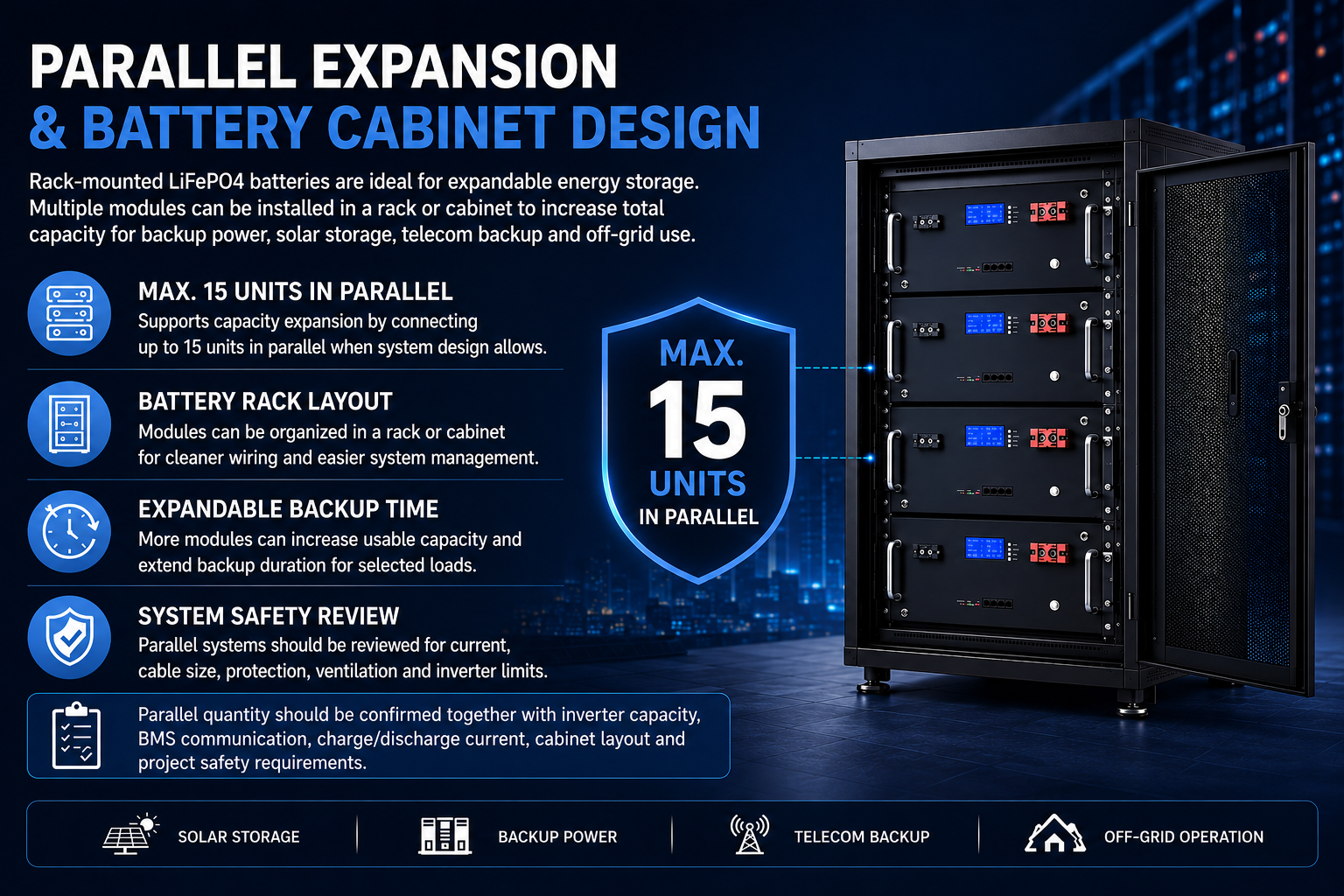
Parallel Expansion and Battery Cabinet Design

Rack-mounted LiFePO4 batteries are suitable for expandable battery banks. Multiple modules can be installed in a rack or battery cabinet to increase total capacity for solar storage, backup power, telecom backup or off-grid operation.

Max. 15 Units in ParallelSupports capacity expansion by connecting up to 15 units in parallel when system design allows.
Battery Rack LayoutModules can be organized in a rack or cabinet for cleaner wiring and easier system management.
Expandable Backup TimeMore modules can increase usable capacity and extend backup duration for selected loads.
System Safety ReviewParallel systems should be reviewed for current, cable size, protection, ventilation and inverter limits.
Parallel quantity should be confirmed together with inverter capacity, BMS communication, charge/discharge current, cabinet layout and project safety requirements.

BMS, Communication and Protection

Rack battery systems depend on BMS monitoring, inverter communication and protection logic. AINEGY rack-mounted LiFePO4 batteries use self-developed BMS, communication protocol customization and 15 layers of protection to support safer and more flexible system integration.
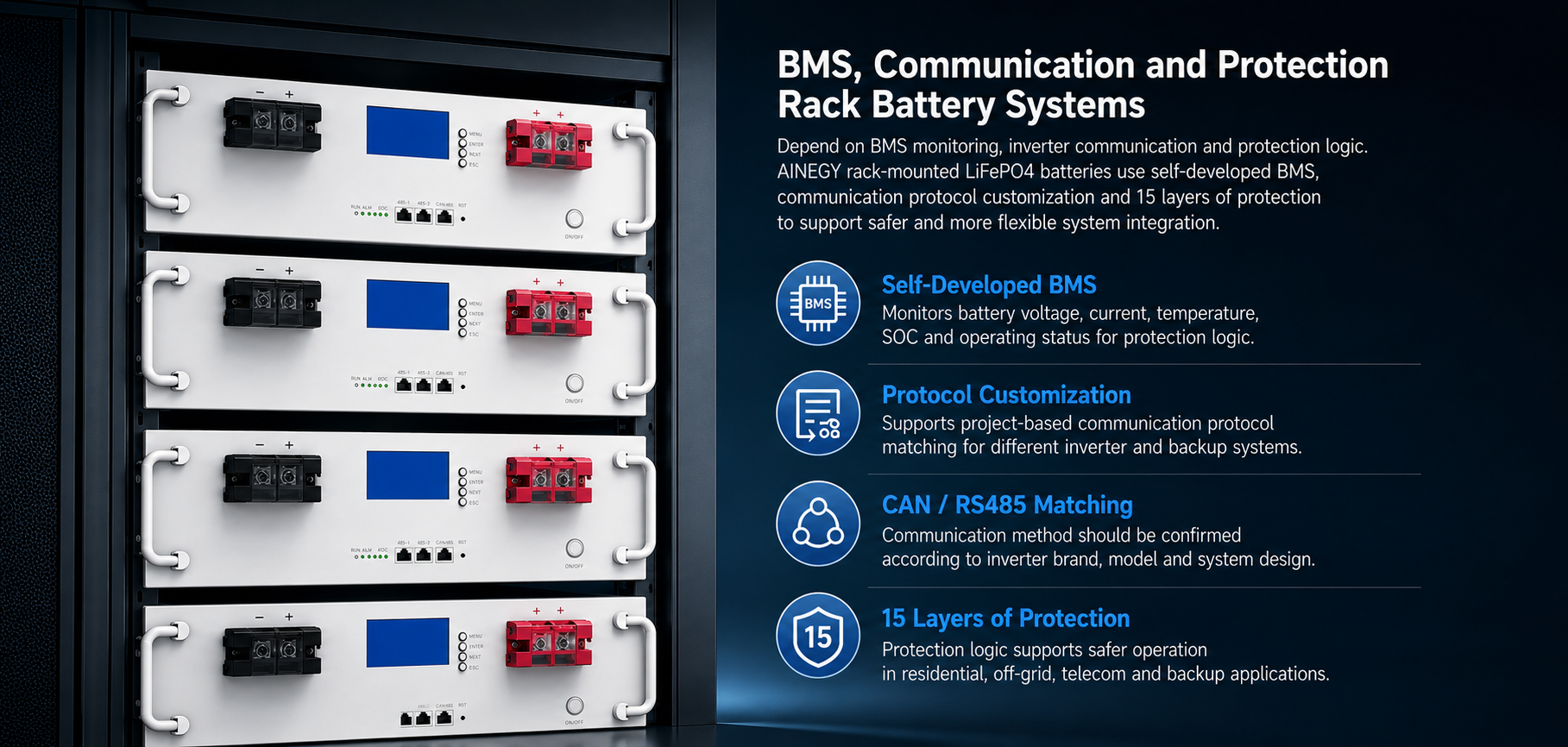
Self-Developed BMSMonitors battery voltage, current, temperature, SOC and operating status for protection logic.
Protocol CustomizationSupports project-based communication protocol matching for different inverter and backup systems.
CAN / RS485 MatchingCommunication method should be confirmed according to inverter brand, model and system design.
15 Layers of ProtectionProtection logic supports safer operation in residential, off-grid, telecom and backup applications.
Rack mount battery inverter communication with BMS, CAN, RS485, solar inverter and energy storage system

Capacity Selection Guide

Rack battery capacity should be selected according to backup duration, inverter power, load size, rack space, cabinet layout and future expansion plan.

100Ah ModelsEntry-capacity rack battery module for small backup systems, compact solar storage and starter battery banks.Entry Capacity
200Ah / 206Ah ModelsBalanced capacity option for home solar storage, rack mount battery backup and small off-grid systems.Balanced Capacity
300Ah / 314Ah ModelsHigher-capacity option for longer backup duration, larger battery racks and higher usable energy demand.Higher Capacity
400Ah ModelsHigh-capacity module option for larger battery banks, off-grid projects and stronger backup power requirements.High Capacity

Typical Applications

AINEGY rack-mounted LiFePO4 batteries are designed for projects where battery modules need to be installed in racks, cabinets or equipment rooms. They are suitable for solar storage, backup power, off-grid systems, telecom backup and small commercial battery banks.
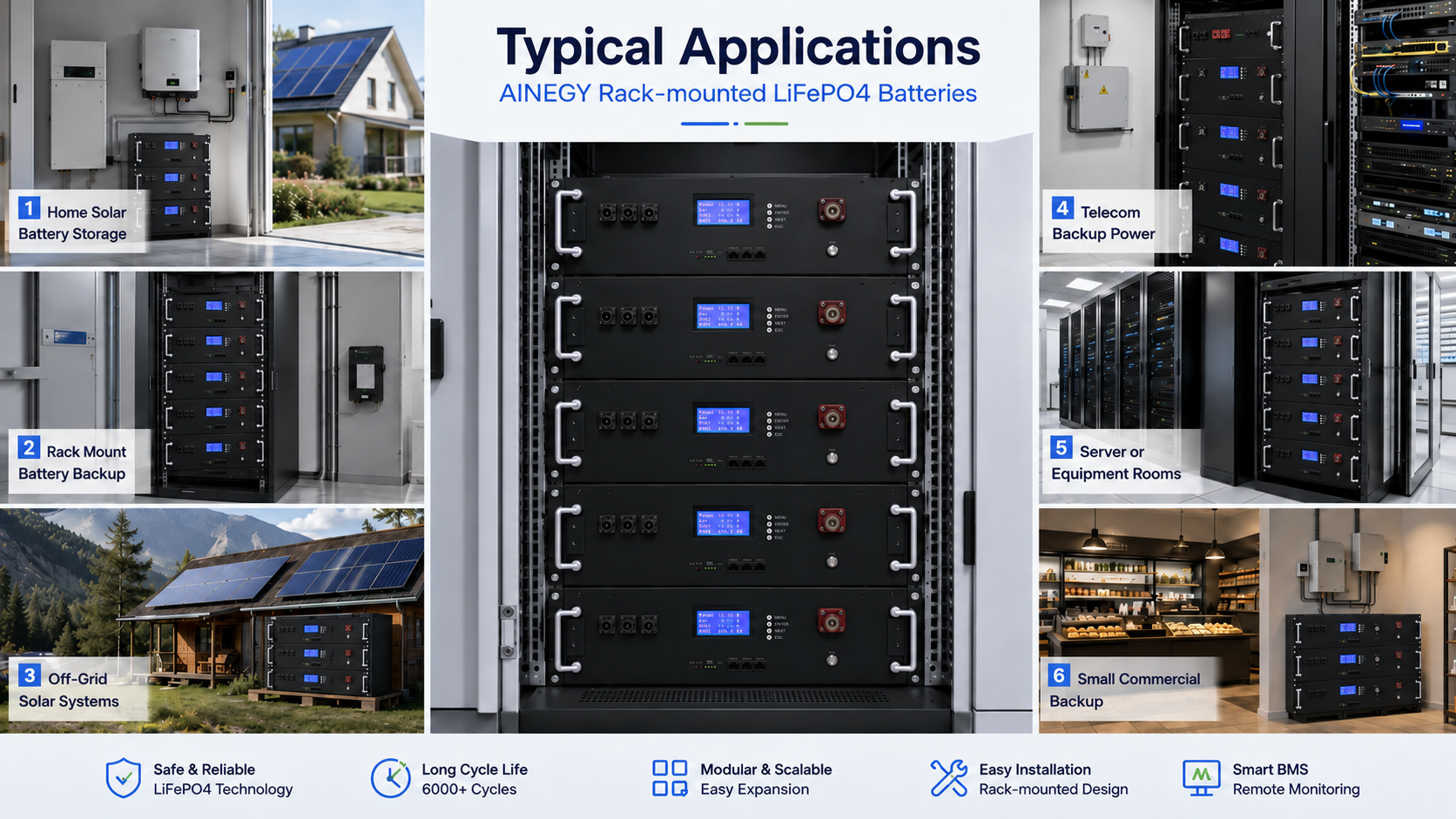
Home Solar Battery StorageFor homes using a rack or battery cabinet instead of wall-mounted installation.
Rack Mount Battery BackupFor backup systems where batteries are managed in a structured rack-based layout.
Off-Grid Solar SystemsFor cabins, rural homes, RV sites or remote systems requiring modular battery expansion.
Telecom Backup PowerFor telecom and communication backup projects that require 48V-class rack battery modules.
Server or Equipment RoomsFor equipment rooms where battery modules need cabinet-based installation and easy access.
Small Commercial BackupFor shops, offices and project sites requiring expandable battery backup systems.
Rack-mounted LiFePO4 battery applications for home solar storage, off-grid systems, telecom backup and equipment rooms

Project Configuration Factors

Before selecting a rack mount battery, confirm battery capacity, rack space, inverter voltage, communication protocol, parallel quantity, backup load, installation cabinet and protection requirements.

Battery CapacitySelect 100Ah, 200Ah, 206Ah, 300Ah, 314Ah or 400Ah according to energy and backup duration targets.
Rack SpaceConfirm battery rack size, module height, cabinet depth, ventilation and maintenance access.
Inverter VoltageConfirm 48V-class inverter compatibility with the 51.2V LiFePO4 battery platform.
Communication ProtocolReview inverter brand, model, firmware, CAN or RS485 communication and protocol requirements.
Parallel QuantityConfirm how many battery modules are required and whether the system supports the planned expansion.
Backup LoadIdentify backup loads, load power, backup duration and expected discharge strategy.
Installation CabinetReview rack structure, cabinet wiring, DC protection, grounding and environmental conditions.
Protection DesignConfirm BMS settings, protection logic, breaker selection, cable sizing and system safety requirements.

FAQ

Common questions about rack-mounted LiFePO4 batteries, 51.2V rack mount battery backup, inverter communication, parallel expansion and solar battery rack systems.

What is a rack-mounted LiFePO4 battery?It is a lithium iron phosphate battery module designed for installation in a rack, cabinet or battery bank system.
What is the difference between rack-mounted and wall-mounted batteries?Rack-mounted batteries are better for modular battery banks and cabinet installation, while wall-mounted batteries are better for compact home wall installation.
Is this a 48V rack mount battery?It uses a 51.2V LiFePO4 platform, which is commonly used in 48V-class solar inverter and backup power systems.
Can rack mount LiFePO4 batteries be used for solar storage?Yes. They can be used for solar battery storage when matched with a suitable inverter, charger and system design.
How many rack battery modules can be connected in parallel?The series supports up to 15 units in parallel, subject to inverter compatibility, BMS communication and system design.
Can the battery communicate with my inverter?Communication protocol customization is available, but final compatibility depends on inverter brand, model, firmware and communication method.
Can it be used for telecom backup?Yes. It can be reviewed for telecom backup projects that require 48V-class rack battery modules and suitable communication configuration.
What should be confirmed before selecting a rack mount battery?Confirm capacity, inverter voltage, communication protocol, rack size, parallel quantity, backup load and installation environment.

Need a Rack Mount LiFePO4 Battery Configuration?

Tell us your required battery capacity, inverter voltage, inverter brand and model, rack space, backup load power, expected backup duration, parallel quantity, communication protocol, cabinet design and installation environment. AINEGY will help match the suitable rack-mounted LiFePO4 battery configuration.